
Slim Sideboards
Slim sideboards are for rooms where a lower storage cabinet needs to use less depth along a wall. Start with actual outer measurements, including any projecting top or handles. Slim is a relative description, not one standard size. Then compare usable internal depth with the objects you need to store; a smaller footprint is useful only when those items can still be reached conveniently.
Read moreRead less
Use this collection to balance depth with capacity and opening movement. Buffets and sideboards provide the wider cabinet guide. Sideboards with storage focus on actual contents, while dining room storage brings chair access into the plan. Choose measured fit rather than accepting a slim-looking front as proof that the route will stay usable.
Showing the single result
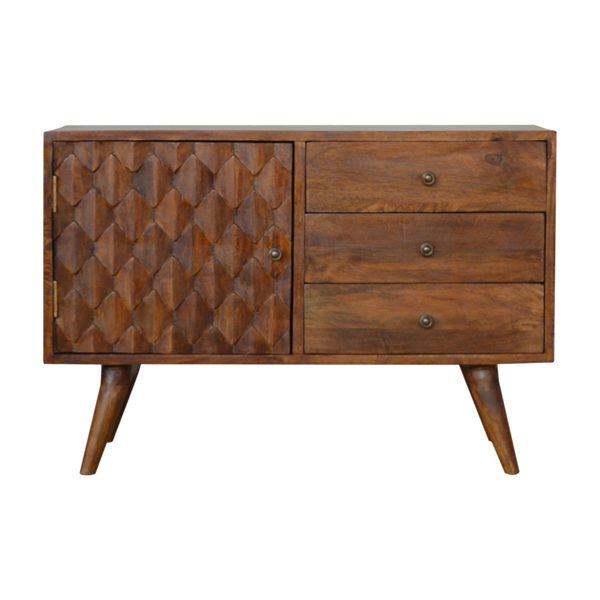

Measure the assembled depth against the wall and route
Read the complete body, top and handles where present. Include skirtings or another fixed wall feature that may change the final position. A listed body depth alone may not describe the furthest projection in the room. Compare the actual assembled outline rather than measuring a visually narrow front.
Mark that footprint with surrounding furniture in use. In a dining space, include chairs pulled back and the route past the cabinet. A slim description cannot replace this occupied layout. Choose the reduced-depth form because its actual placement leaves practical access, not because a photograph makes the cabinet appear shallow against an empty wall.
Check what the shallower compartments can actually hold
Measure the objects in their planned storage orientation and leave lifting space. Compare usable internal depth, width and height, including dividers and fittings. Outer cabinet depth is not the clear interior. A wide plate or box may decide the choice more than the amount of floor saved.
Read the actual shelf or drawer layout. Sideboards with shelves help compare larger groups; sideboards with drawers focus on smaller sorting. Do not assume rotating an object makes retrieval convenient without checking the opening. Choose a slim cabinet that serves the important contents, rather than replacing useful storage with a shape that only fits the wall.
Allow room to use the openings and top
Plot the documented door or drawer movement beyond the closed cabinet. Include the person removing objects and furniture nearby. Reduced depth does not automatically mean a small opening path. Read any alternative mechanism only where the actual product supplies it; the slim label does not establish sliding doors or folding parts.
Decide whether the top’s usable area supports its intended display or temporary task. Follow material, loading and care guidance rather than treating a narrow top as a broad serving surface. Check installation instructions and delivery access, then ask benssur about unclear projections or internal dimensions. The useful slim sideboard should save the space you need while remaining practical to open and use.